Socializing a Bernese Mountain Dog With Kids, Dogs and Strangers
General training information. Every dog is an individual; for health or behavior concerns, see your veterinarian.
Berners look like teddy bears, and many people assume they will charm every child, dog and stranger on their own. The breed's own standard paints a more careful picture. Good socialization is how you turn a good-natured dog into a calm, confident one.
This guide walks you through a practical Bernese Mountain Dog socialization plan, one step at a time. It uses gentle, reward-based methods in line with the American Veterinary Society of Animal Behavior (AVSAB). For the wider picture of obedience and manners, see our complete guide to training a Bernese Mountain Dog.
What the Breed Standard Says About Temperament
The Bernese Mountain Dog Club of America (BMDCA) publishes the breed standard, which is the AKC standard. It describes the Bernese as self-confident, alert and good-natured, never sharp or shy. It also allows the dog to stay aloof with strangers.
That last point matters. An aloof dog is not a broken dog. Your goal is not to make your Berner adore every person it meets. Your goal is a dog that stays relaxed, polite and neutral around people, animals and new places.
Individual dogs vary, so treat this as a starting point and watch your own dog.
Are Bernese Mountain Dogs Good With Kids?
Hill's Pet describes the breed as patient and gentle with children when well socialized. Notice the condition in that sentence. The gentle reputation depends on good early experiences and good management, not on breed alone.
Size is also a factor. The BMDCA standard gives dogs a height of 25 to 27.5 inches and bitches 23 to 26 inches at the withers. Hill's lists a weight range of 70 to 115 pounds. Even a friendly, clumsy adolescent of that size can knock a small child over by accident.
Hill's also notes the breed's original work on Swiss farms: herding livestock, guarding property and hauling carts. We have no breed source saying Berners nip or herd children as a rule. Still, it is sensible to watch for leaning, blocking, circling or mouthing around running kids, and to interrupt those habits early and kindly. If they show up or worry you, ask a qualified trainer or your veterinarian for help.
Bernese Mountain Dog With Other Dogs
We could not confirm a breed-wide rating for how Berners get along with other dogs. Check with the BMDCA, a local Bernese club or your dog's breeder for guidance on your own dog's line.
What you can do is build good habits with controlled, positive meetings. Quality matters more than quantity. A few calm greetings with steady, friendly dogs teach more than a chaotic dog park visit.
Materials You Will Need
- A flat collar or a well-fitted harness, and a standard 4 to 6 foot leash.
- A long line (15 to 30 feet) for distance work in open areas.
- Small, soft, high-value treats you can deliver quickly. Count them as part of the daily food allowance and ask your veterinarian about your dog's diet.
- A mat or blanket as a settle spot.
- A baby gate or pen to give your dog a break from visitors and kids.
- A stable of calm helpers: friendly adults, a few considerate children and a few steady, vaccinated adult dogs.
- Water and shade. Hill's lists heat sensitivity as a breed challenge, so plan outings for cool parts of the day.
Ask your veterinarian when your puppy can safely go out in public and meet other dogs. We could not confirm a developmental timeline from a club or vet source, so your vet is the right person to ask about timing.
Step-by-Step Socialization Plan
Step 1: Start With Calm at Home
Before you introduce anyone, teach your dog that settling on a mat earns rewards. Reward your dog for lying down quietly while normal household life goes on. A dog that knows how to settle has an easier time with every later step.
Keep sessions short. A few minutes at a time is plenty.
Step 2: Build Positive Associations With New Sights and Sounds
Pair new things with treats: bicycles, strollers, umbrellas, delivery people, hats, different floor surfaces. Let your dog look from a distance where it feels comfortable. Treat when it notices something, then move away before it gets worried.
Hill's describes the breed as sensitive, so harsh corrections or loud voices can shut a dog down. Keep your tone upbeat and let your dog set the pace.
Step 3: Introduce Strangers on Your Dog's Terms
Because the standard allows aloofness, do not force greetings. Ask visitors to ignore your dog at first, stand side-on and let the dog approach if it wants to. Reward calm behavior, whether the dog sniffs, sits or simply watches.
Ask guests not to lean over the dog, grab its face or hug it. If your dog steps back, let it. A Berner that learns it has a choice tends to feel safer.
Step 4: Teach Polite Greetings
Practice "sit to say hello." Hold a treat low, ask for a sit and let the guest pet your dog on the chest or shoulder only while all four paws or the bottom stay on the floor. If the dog jumps, the greeting pauses. When it sits, the greeting resumes.
This matters for a dog that may weigh as much as an adult person. Work on it while your dog is still small.
Step 5: Set Up Safe Time With Children
Teach children the rules first, away from the dog:
- Walk, do not run or scream, near the dog.
- Pet gently on the chest or shoulder, not the face, tail or ears.
- Never climb on, hug tightly or ride the dog.
- Leave the dog alone when it is eating, chewing or resting in its spot.
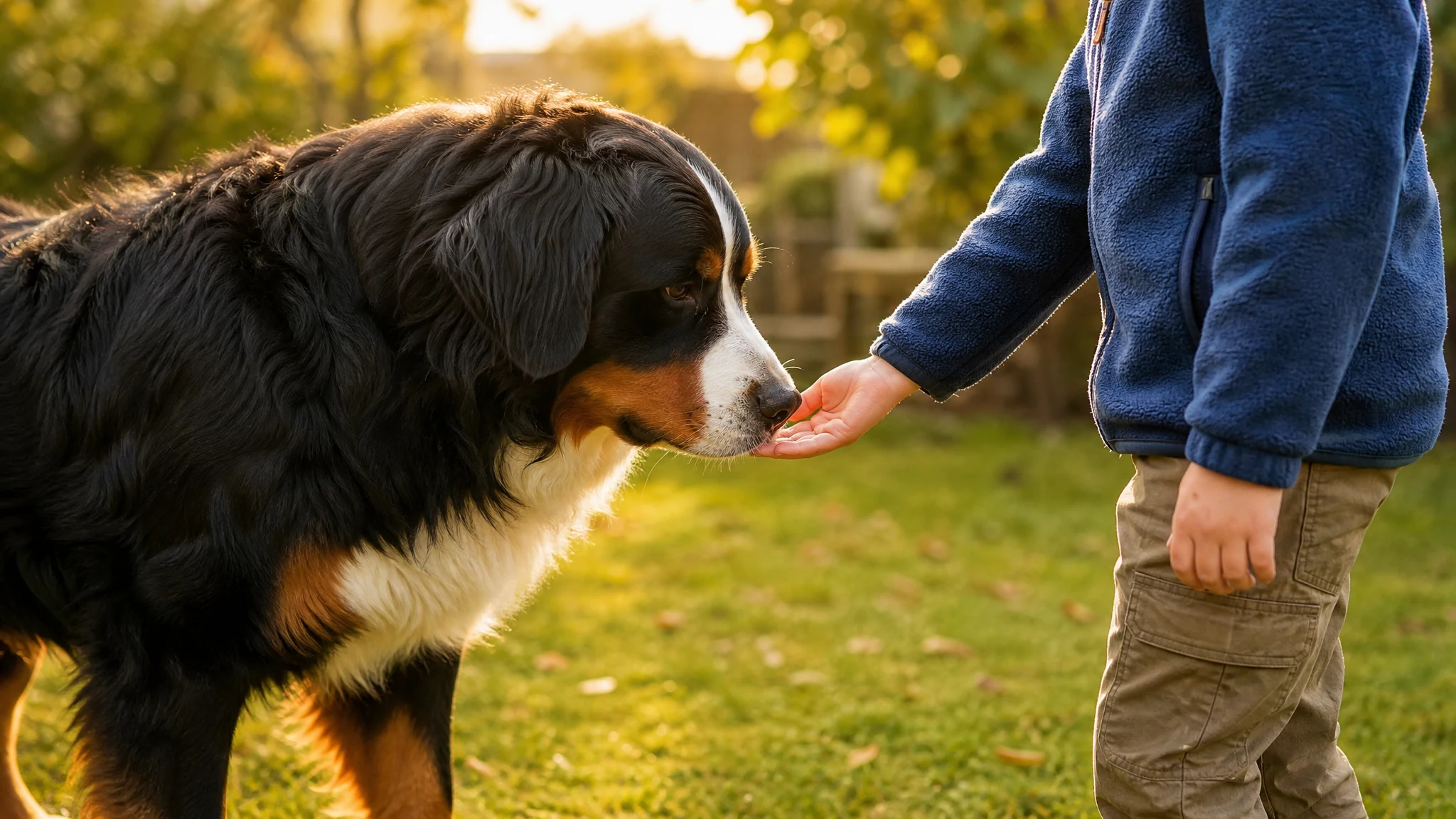
Then keep sessions short and supervised. Have the child toss a treat or offer one from a flat hand while you hold the leash. Stop while everyone is still happy.
An adult should always be within arm's reach when a young child and a dog are together. When you cannot watch closely, use a gate or pen. This is the best protection for the child and the dog.
Step 6: Watch for Herding and Guarding Habits
Because the breed worked on farms herding and guarding, keep an eye out for these around kids:
- Mouthing or grabbing at clothes or hands while children run.
- Circling or blocking children in a doorway or yard.
- Stiffening, freezing or guarding a toy, bone or spot.
Calmly redirect to a mat or a toy and reward the switch. Never punish a growl, since that can hide a warning that you need. If guarding or mouthing continues, contact a qualified, reward-based trainer or your veterinarian.
Step 7: Introduce Other Dogs Slowly
Start with parallel walks. Walk your dog and a calm, friendly dog on the same route at a comfortable distance, both on leash. Reward your dog for looking at the other dog, then looking back at you.
Over several sessions, reduce the distance if both dogs stay loose and relaxed. When you allow a greeting, keep it brief, with loose leashes, and call the dogs apart before things get too excited. A few seconds is enough.
Look for loose, wiggly bodies and play bows. Pause the meeting if you see stiffness, hard staring or pinned-down dogs.
Step 8: Practice in Real Places
Once your dog does well at home and in quiet spots, visit busier places one at a time, such as a park path or outdoor cafe patio. Hill's rates the breed's energy as moderate, around 3 on its 1 to 5 scale, and suggests one to two daily walks or hikes with light play. Use some of those walks as socialization time, but keep your dog from getting overtired or overheated.
Quit while your dog is still doing well. A short, successful outing beats a long, stressful one.
Tips for Better Results
- Keep sessions short. Five to ten minutes is often enough.
- Reward calm, not excitement. Treat the quiet moments you want more of.
- Use a break spot. Let your dog retreat to a gate-protected area whenever it wants.
- Choose helpers carefully. A few steady dogs and considerate people teach better than a crowd.
- Keep going. Social skills need regular practice through adolescence and adulthood.
- Plan for coat and weather. Hill's notes the breed sheds year-round and heavily in spring and fall, and tends to run hot, so groom regularly and choose cool times of day.
Common Mistakes to Avoid
- Assuming gentle means unsupervised. Even a well-socialized dog needs supervision around children.
- Forcing greetings. Pushing an aloof dog toward strangers can teach it that people are a problem.
- Flooding. Dumping a young dog into a loud, crowded place can backfire.
- Using harsh corrections. Shock, prong and choke collars, scruffing and alpha rolls are not part of humane training and can make a sensitive dog worse.
- Relying on the dog park. Uncontrolled play with unknown dogs is a gamble.
- Ignoring early warning signs. Lip licking, yawning, turning away or freezing are requests for space.
- Stopping after puppyhood. Keep up gentle exposure as your dog matures.
What Results to Expect
With patient, consistent practice, many owners find their Bernese becomes calmer and more comfortable around visitors, children and other dogs. Progress varies from dog to dog, and no plan can promise a particular outcome.
Some Berners will always be a bit reserved with strangers, which the breed standard allows. A relaxed, polite dog that tolerates new people without stress is a realistic goal. If your dog shows fear, tension or aggression that does not improve, talk to your veterinarian, who can rule out health causes and refer you to a qualified behavior professional.
A Note on Health and Handling
Health questions, including pain, sudden behavior changes or timing for vaccines and outings, belong with your veterinarian. If you are choosing a puppy, the BMDCA recommended testing page lists the screens its members use, including hips, elbows, eyes, heart and degenerative myelopathy. A reputable breeder can explain the results for the parents.