How Much Exercise Does a Bernese Mountain Dog Need? Plus Brain Games
General training information. Every dog is an individual; for health or behavior concerns, see your veterinarian.
Berners look like gentle, fluffy couch cushions. Then you meet one at the end of a leash on a cool fall morning, and you see how much they enjoy a job. The honest answer to how much exercise a Bernese Mountain Dog needs is: a steady, moderate amount, plus real mental work.
This guide walks you through building a daily routine in simple steps. It covers physical exercise, brain games and the mistakes that trip up new owners. Every dog is an individual, so treat the numbers here as a starting point and adjust with your veterinarian.
What the Breed Sources Say About Exercise
Hill's Pet rates the Bernese Mountain Dog a 3 on its 1 to 5 energy scale, which it calls moderate energy. For exercise, Hill's describes one to two daily walks or hikes with light play or enrichment. That is a useful baseline, and it is a gentler target than many working breeds need.
Hill's also notes the breed is sensitive to heat, which shapes when and how you exercise. Hill's rates barking at 2 (quiet), so a bored Berner may not announce it with noise. Boredom can show up in other ways, so mental work matters as much as miles.
The breed's history explains the mix. According to Hill's, the Bernese came from the Bern canton in the Swiss Alps. It worked on farms herding livestock, guarding property and hauling carts. That is a dog built for steady, purposeful effort, not all-day sprinting.
Individual dogs vary. Some will want more, some less. Your veterinarian is the right person to set limits for your own dog.
Materials You Will Need
- A flat or front-clip harness and a standard leash that fit well. Avoid prong, choke and shock tools. They do not fit humane, reward-based training.
- A long line (a lightweight leash of 15 to 30 feet) for sniff walks in safe, open areas.
- Small, soft treats, or part of your dog's daily meal portion.
- A puzzle feeder, snuffle mat or lick mat.
- Cardboard boxes, towels and paper bags for homemade games.
- Fresh water and a collapsible bowl for every outing.
- A notebook or phone notes to track what your dog enjoys.
Step-by-Step: Build Your Bernese Exercise Routine
Step 1: Start with your veterinarian
Before you set a plan, ask your vet what is safe for your dog's age, weight and joints. The sources used for this article do not give a confirmed growth or maturity timeline for the breed. So there is no reliable puppy exercise number to quote here. Ask your vet and your breeder or the Bernese Mountain Dog Club of America (BMDCA) how much is too much for a growing puppy.
This matters because the BMDCA recommends screening for hips and elbows in the breed. Joints are worth protecting from the start. Never push a young dog through long, repetitive or high-impact exercise without veterinary guidance.
Step 2: Set a daily baseline of one to two walks
Use the Hill's guidance of one to two daily walks or hikes as your anchor. Many owners split the day into a morning walk and a shorter evening outing. Keep the pace relaxed and let your dog set the tempo at times.
Watch your dog, not the clock. Heavy panting, lagging behind or lying down on the trail mean it is time to stop and rest. If you are unsure whether your dog is overdoing it, call your vet.
Step 3: Plan around heat
Hill's lists heat sensitivity among the breed's challenges. In warm months, walk early in the morning or after sunset. Choose shade and grass over hot pavement. Carry water and take breaks.
If your dog seems overheated, stop, move to shade and contact a veterinarian. Do not wait to see if it passes.
Step 4: Turn some walks into sniff walks
A sniff walk is a slower outing where your dog chooses where to investigate. Use a long line in a safe, legal area, or a regular leash on quiet streets. Let your dog sniff grass edges, trees and corners without hurrying along.
Sniffing is mentally tiring for many dogs. A short sniff walk can be a good swap on days when it is too hot, too icy or your dog needs a lighter day. Try one sniff-focused walk a few times a week and see how your dog settles afterward.
Step 5: Add light play and enrichment
Hill's pairs the daily walks with light play or enrichment. Think gentle tug with a soft toy, a slow game of fetch on grass, or a short session with a snuffle mat. Keep it relaxed and stop while your dog still wants more.
Avoid long bouts of hard jumping and sharp turns, especially for young dogs. Ask your vet what suits your dog.
Step 6: Add brain games that fit the breed's original jobs
This is where Bernese mental stimulation gets fun. The breed's roots in herding, guarding and cart hauling give you a ready list of ideas. You do not need to replicate the work. You just need to give your dog a purpose.
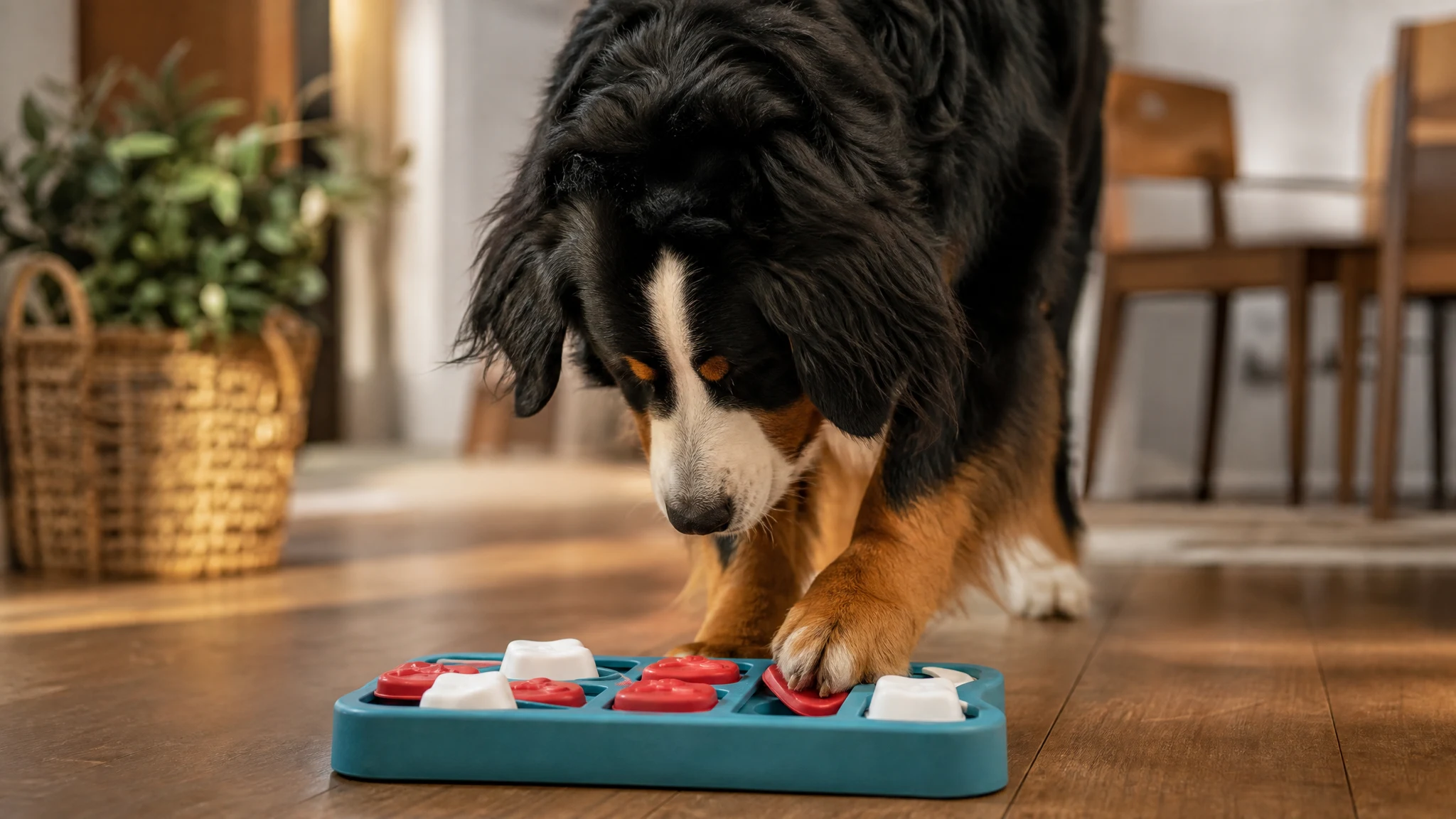
Puzzle feeders and food games. Serve part of a meal from a puzzle feeder, snuffle mat or lick mat. Start with easy versions so your dog succeeds, then make it harder over time. Always supervise, and remove any toy your dog starts to chew apart.
Find-it scatter. Toss a few treats into short grass and say "find it." As your dog gets good, hide treats around a room or garden. This is a simple nose game that requires no equipment.
Towel roll. Lay treats on a towel, roll it up loosely and let your dog work it open. Use a cardboard box or paper bag for variety, but take away anything your dog tries to swallow.
Carry and fetch jobs. The breed hauled carts, so many Berners enjoy carrying things. Teach your dog to carry a soft toy or a light bag, then reward with a treat and praise. Keep loads light and sessions short. Do not attach any weight or cart until you have talked to your vet and a qualified draft instructor.
Settle and stay games. A guarding dog benefits from learning calm. Reward your dog for lying on a mat while you move around, and gradually add distractions like a doorbell sound. This builds the skill of relaxing even when something is going on.
Name-the-toy games. Teach your dog the names of two or three toys, then ask for one by name. Reward each correct pick with a treat. It is a quiet, low-impact game that uses brainpower.
Herding-style recall games. With a second person, call your dog back and forth between you and reward each arrival. It uses the breed's willingness to work with people and keeps recall sharp. Use a long line outdoors unless the area is fully fenced.
The Hill's description of the breed as sensitive supports a gentle approach here. Keep your voice friendly, rewards generous and sessions short. Harsh corrections or loud voices can shut a sensitive dog down.
Step 7: Consider a dog sport or structured activity
The BMDCA says its regional clubs hold Draft, Rally and Obedience events, and the club awards Draft, Working Dog and Versatility titles. These are an option if you want a long-term project with your dog. Contact the BMDCA or a regional Bernese club to learn what is offered near you and what age and health clearances apply.
Do not start any sport without checking with your veterinarian first, especially anything involving pulling, jumping or carrying weight.
Step 8: Build in socialization and calm exposure
The breed standard, as published by the BMDCA, describes the Bernese as self-confident, alert and good-natured, never sharp or shy. It also allows the dog to be aloof with strangers. That is why calm, positive exposure to new people, places and sounds matters.
Pair outings with treats and keep encounters relaxed. Do not force your dog to greet people. Ask a trainer who uses reward-based methods if your dog seems worried.
Step 9: Track, adjust and rest
Keep simple notes for a few weeks. Write down the activity, how long it took and how your dog behaved afterward. Look for a dog who is relaxed and content, not wired or exhausted.
Schedule lighter days. Rest is part of the routine, not a failure of it.
Sample Day for an Adult Bernese
| Time | Activity |
|---|---|
| Morning | Walk at an easy pace, with time to sniff |
| Midday | Part of a meal in a puzzle feeder or snuffle mat |
| Afternoon | Short training game, such as find-it or settle on a mat |
| Evening | Second walk, shorter if it is warm, plus light play |
This is an example, not a prescription. Your vet can help you adjust it for age, weight and health.
Tips for Success
- Keep sessions short and end on a win.
- Rotate puzzle toys so they stay interesting.
- Use part of your dog's daily food for games to avoid extra calories.
- Choose cool parts of the day in warm weather.
- Reward calm behavior at home, not just activity outside.
- Be patient. A sensitive dog learns best when it feels safe.
For a wider look at manners, socialization and daily habits, see our complete guide to Bernese Mountain Dog training.
Common Mistakes to Avoid
- Too much, too young. Long, hard exercise for a growing puppy can stress developing joints. Get your vet's guidance on limits.
- Exercising in the heat. Hill's flags heat sensitivity. Adjust your schedule instead of pushing through.
- Relying on miles alone. A tired body does not always mean a satisfied mind. Add brain games.
- Harsh corrections. Sensitive dogs can shut down. Reward what you want instead.
- Skipping socialization. The standard allows aloofness with strangers, so gentle practice helps your dog stay comfortable.
- Using the wrong tools. Prong, choke and shock collars are not part of humane training, and the AVSAB advises against aversive methods.
- Ignoring signs of pain. If your dog limps, hesitates on stairs or seems stiff, call your vet. Do not guess.
What Results to Expect
With a steady routine, many owners find their dog is calmer at home and more settled in the evening. A mix of walks, sniffing and brain games may also help reduce boredom-driven habits, such as chewing or pestering. Results vary from dog to dog, and no routine can promise a particular outcome.
Give any new habit a few weeks before judging it. If you see sudden changes in energy, appetite or mobility, talk to your veterinarian rather than adjusting the routine yourself.
Life Stages: What We Can and Cannot Say
Puppies. The sources reviewed do not give a confirmed puppy exercise limit or maturity timeline for the breed. Ask your vet, your breeder and the BMDCA. Focus on short, gentle play, calm socialization and simple brain games.
Adults. Hill's guidance of one to two daily walks or hikes with light play or enrichment is the best published baseline in the sources used here.
Seniors. No breed source reviewed gives specific senior exercise numbers. Hill's gives a lifespan of 7 to 10 years, while the BMDCA says 7 to 8 years is too short. Ask your vet how to adapt walks, rest and games as your dog ages.
Size and Health Context
The breed standard published by the BMDCA gives dogs a height of 25 to 27.5 inches and bitches 23 to 26 inches at the withers. Hill's lists weight at 70 to 115 pounds, with males heavier. A big dog puts real load on joints, which is one more reason to keep exercise steady and avoid sudden extremes.
The BMDCA recommended testing page lists hips, elbows, eyes, heart and degenerative myelopathy (DM), plus one optional test. Ask your breeder about these results, and ask your vet what they mean for your dog's activity.
Final Thoughts
A Bernese Mountain Dog does best with a calm, regular routine of walks, sniffing and games that use its mind. Start modest, watch your dog and lean on your vet for any health or age questions. Keep the work kind, and your dog is likely to enjoy it as much as you do.